



Organizational Capability & The AI Race
A Talent & Operating Model Perspective for Commodity Trading in 2026 *Obligatory disclaimer: Aurex Group is a commodities recruitment firm. Our perspective is shaped by ongoing conversations with global commodity trading executives and with AI professionals in adjacent talent pools across big tech, AI-native companies, quant hedge funds, systematic trading firms, investment banks, and advanced…
A Talent & Operating Model Perspective for Commodity Trading in 2026
*Obligatory disclaimer: Aurex Group is a commodities recruitment firm. Our perspective is shaped by ongoing conversations with global commodity trading executives and with AI professionals in adjacent talent pools across big tech, AI-native companies, quant hedge funds, systematic trading firms, investment banks, and advanced analytics boutiques. We also maintain a healthy bias toward keeping capable humans firmly in the loop.
Who Is leading the AI Race in Commodity Trading?
The honest answer: it’s complicated.
Advanced analytics, forecasting models, and quantitative execution have been embedded in commodity markets for decades. Power traders optimized dispatch curves long before generative AI. Natural gas desks built storage and basis models years ago. Hedge funds clustered signals across multi-asset portfolios using machine learning well before recent technological breakthroughs.
AI hasn’t suddenly arrived. What’s changed is the cost, accessibility, and deployment speed of intelligent systems.
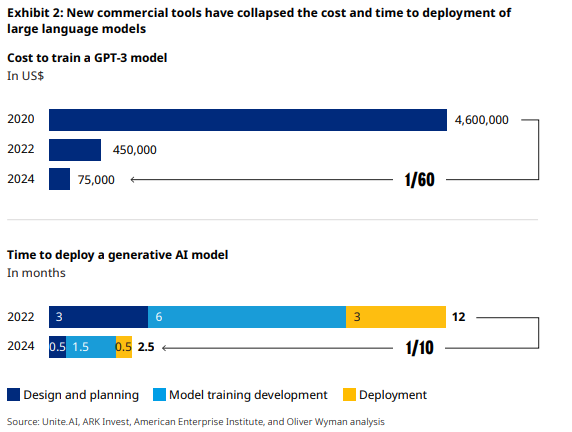
Oliver Wyman’s analysis shows that the cost of training large language models has fallen roughly 60-fold since 2020, while time to deployment has compressed from roughly 12 months to as little as 12 weeks.
That shift is pulling AI out of isolated quant teams and into the center of how physical and financial commodity trading businesses operate.
The AI race in commodity trading is less a technology race than an organizational readiness race.
The Broader Reality: Adoption Is Widespread, Impact Is Uneven
Across industries, AI adoption is real and accelerating.
A February 2026 NBER working paper surveying nearly 6,000 firms across the US, UK, Germany, and Australia finds that approximately ~70% of firms report using some form of AI technology (Yotzov et al., 2026, NBER Working Paper 34836). Yet over 80% report little to no measurable impact on employment or productivity over the past three years.
Executives expect larger productivity gains ahead — roughly 1.4% over the next three years — but the realized impact to date has been modest.
This is a modern version of the productivity paradox, and adoption does not automatically translate into transformation.
Commodity trading is no exception.
Public headlines suggest strategic urgency. Trafigura’s CEO recently stated that AI needs to be used in “everything we do.” At the same time, cross-industry data — and confidential search conversations within commodity markets — suggest that measurable productivity gains remain uneven and unclear.
Where AI Deployment Is Actually Happening
From active mandates across trading houses, utilities, and integrated energy firms, three deployment patterns are consistent:
1. Secure Enterprise LLM Overlays
Proprietary internal assistants layered across CTRM and risk workflows, contracts, shipping, operations, and documentation libraries.
These tools prioritize:
- Retrieval accuracy
- Access controls
- Audit trails
AWS published a case study on TotalEnergies Trading & Shipping describing generative AI matching structured and unstructured transaction data to improve traceability and error detection. The common theme: AI as workflow enhancement across the trade lifecycle, not as a speculative prediction engine.
2. Task-Specific AI Agents
Focused automation in:
- Confirmation exceptions
- Settlement mismatches
- Credit and collateral checks
- Document parsing
- Regulatory reporting support
These are high-volume, rules-driven environments where friction reduction creates durable value.
3. Architecture Modernization
AI initiatives frequently trigger broader conversations about CTRM modernization, APIs, and workflow redesign.
This may be less glamorous than predictive trading models, but it is strategically durable.
AI scales best on structured infrastructure.
Why AI Rollouts Feel “Choppy” in Commodity Trading
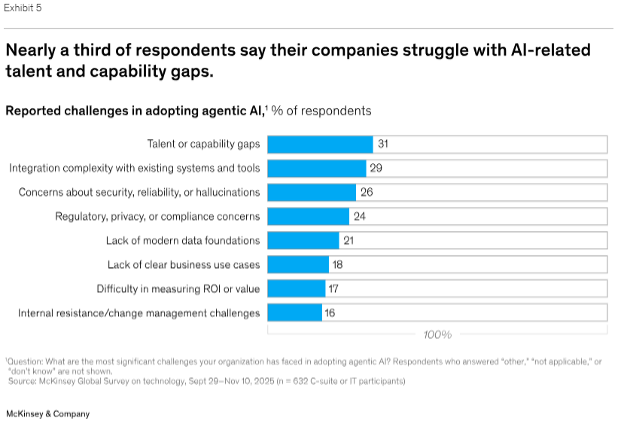
From our conversations, three structural constraints consistently emerge.
1. Data Readiness Gaps
AI amplifies the quality — or fragmentation — of underlying systems. If contracts, logistics data, risk systems, and settlements live in siloed environments, AI exposes those weaknesses quickly. Worse yet, siloed trading teams working off of independent spreadsheets & trading infrastructure.
Oliver Wyman data shows that over the past five to six years, IT investment across leading commodity trading organizations increased by nearly 50%, with IT headcount and spending per role rising significantly. Those investments reflect foundational work required before generative AI can scale from pilot to platform.
In commodity markets, AI can act as the connective tissue across the trade lifecycle, but it’s not a magic overlay.
2. Governance and Control Requirements
Commodity trading firms cannot tolerate opaque automation in sensitive workflows involving derivatives, margining, counterparty exposure, or regulatory reporting. AI processes must be auditable, explainable, and controllable, and many organizations are still formalizing governance policies around both system implementation and employee usage.
The NBER research further highlights a gap in expectations between executives and employees regarding AI’s employment impact — underscoring the importance of transparent governance and communication.
This is not about slowing innovation.
It is about scaling it responsibly.
3. Human Adoption & Trust
AI delivers value only if teams trust it, and where the messaging is clear across front, middle, and back office teams.
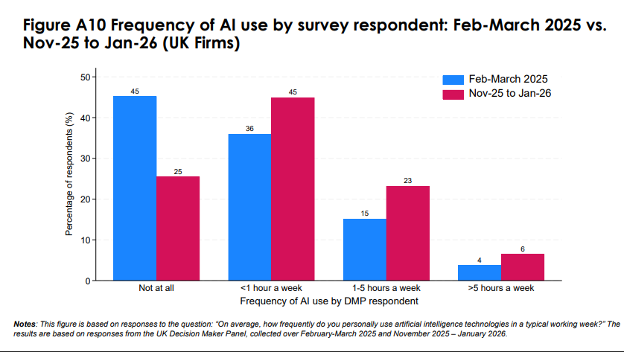
Across industries, senior executives report using AI only about 1.5 hours per week on average (NBER, 2026). Adoption exists, but depth of integration remains early.
Change Leadership Is the Critical Variable
The technology conversation is mature. The human conversation is not.
The most successful AI transformations we see have visible C-suite endorsement — whether from the CEO, COO, CRO, or CIO — coupled with a clearly communicated roadmap tied to commercial outcomes. When AI is positioned as a side initiative owned solely by IT, or only by the CRO, momentum fades. When it is framed as operating model transformation sponsored at the executive level, adoption accelerates.
Within commodity trading organizations, AI initiatives rarely fail because the model is weak. They stall because sponsorship is unclear, or that front office teams are resistant. If AI implementations are perceived as “another IT side project”, resistance builds quickly.
We have also seen turnover tied to these programs. In some cases, an AI professional’s departure stems from lack of executive alignment between technical and commercial leadership. In others, highly technical hires struggle to build credibility across trading and operational teams, or they’re just the wrong cultural fit. Strong technical capability alone does not guarantee change leadership.
These are not arguments against technologists, but rather arguments for hiring differently.
The firms making measurable progress are not simply hiring more engineers. They are hiring individuals who can:
- Translate AI into commercial trading outcomes
- Align front office and control functions
- Redesign workflows
- Communicate technical implications clearly to non-technical stakeholders
- Maintain governance discipline
This is not purely a data science hire. It is a leadership hire.
Alexander Sukharevsky, Senior Partner and Global Co-Leader of QuantumBlack, AI by McKinsey
“The more we see organizations using AI, the more we recognize that it takes a top-down process to really move the needle. Effective AI implementation starts with a fully committed C-suite and, ideally, an engaged board. Many companies’ instinct is to delegate implementation to the IT or digital department, but over and over again, this turns out to be a recipe for failure”
Why Commodity Context Still Matters in AI Hiring
AI talent is in high demand across technology companies, hedge funds, banks, large corporates, and virtually every major industry worldwide.
In commodities, mandates are rarely framed as “we need to hire an AI engineer.”
They are framed as: “We need someone who can translate AI into our trading operating model.”
Many highly technical AI professionals have never operated inside a physical commodity platform. They may understand models and data deeply but have limited exposure to trade lifecycle complexity, market risk, margin and liquidity constraints, operational risk, counterparty dynamics, and the real-world decision flows inside merchant organizations.
Bridging that gap requires individuals who combine technical fluency with commercial empathy. It requires AI professionals , across seniorities, who can sit with a trader in the morning, a risk committee at lunch, and the IT team in the afternoon, and be credible in every room.
That profile is rare. And it is highly competitive.
Closing Comments: The Talent Advantage
The firms that will lead in 2026 are not necessarily those experimenting fastest. They are those hiring deliberately and attracting individuals with the right balance of technical depth, domain understanding, and change leadership.
At Aurex, our deep roots in commodities, coupled with deliberate expansion into adjacent AI talent pools over the past several years, position us at the intersection of:
- Technical AI capability
- Commodities domain knowledge
- Operating model transformation
- Governance awareness
The market for these profiles is increasingly competitive and often opaque. Many of these candidates are industry outsiders, which means thoughtful engagement and positioning matter. Firms must clearly articulate platform opportunity, culture, long-term vision, and the strategic importance of the role.
That conversation is rarely transactional.
Note: This article was written February 27, 2026. Given the pace of change in this space, parts of it will likely feel outdated by the time you read it — which may be the most accurate signal of all.
References:
- AWS re:Invent 2025 — Increasing Productivity in Energy Trading with Generative AI (PDF)
- National Bureau of Economic Research (NBER) Working Paper No. 34836 — Firm Data on AI (Yotzov, Barrero, Bloom, et al.)
- McKinsey & Company — The State of AI: How Organizations Are Rewiring to Capture Value
- McKinsey Global Technology Agenda 2026 — Tech Trends Outlook
- S. Commodity Futures Trading Commission (CFTC) — CFTC Staff Issues Advisory Related to the Use of Artificial Intelligence by CFTC-Registered Entities and Registrants (Release No. 9013-24)
- Trafigura — Executive Commentary on AI Adoption (“We need to use AI in everything we do”)
- Oliver Wyman — Transforming Commodity Trading with Generative AI (AI visionaries vs challengers analysis)
- Ernst & Young — Why autonomous trade operations are the next leap in commodities trading